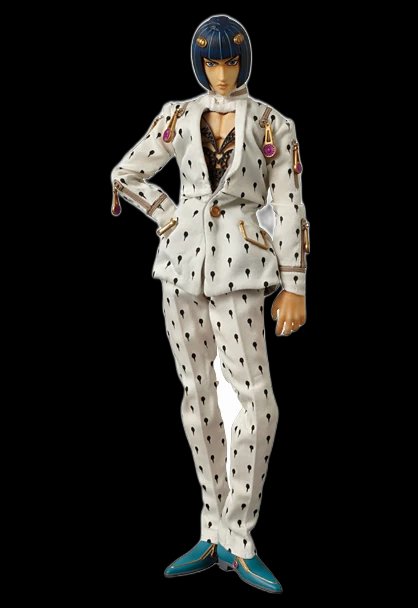
Bruno Bucciarati, the fiercely principled capo of Passione, stands as one of JoJo's Bizarre Adventure's most beloved characters. Armed with the zipper-creating Stand Sticky Fingers, he leads his team through Golden Wind with unwavering moral conviction. His decision to betray the Boss of Passione to protect a young girl's life defines a story arc filled with sacrifice, loyalty, and tragic heroism.
Species: Human · Stand: Sticky Fingers · Affiliation: Passione · First Appearance: Chapter 445 (1995)
Overview
Bruno Bucciarati debuts in Part 5: Golden Wind as a capo within the Italian mafia organization Passione. Born in a small Italian fishing town, Bucciarati's life takes a dark turn when his father is attacked by drug dealers, leaving him severely disabled. The young Bucciarati tracks down the attackers and kills them himself, an act that draws the attention of Passione recruiters. He rises through the ranks through competence and unwavering principles, eventually commanding his own team of Stand users.
When Giorno Giovanna seeks to join Passione, Bucciarati is assigned to evaluate him. The two clash initially but quickly recognize a shared vision of justice. Bucciarati accepts Giorno into his team, setting in motion events that will challenge everything he believes about loyalty, duty, and the organization he serves. His assignment to protect Trish Una, the Boss's daughter, becomes the catalyst for his rebellion against the most powerful man in Italy.
What makes Bucciarati exceptional is his moral clarity in a world of gray compromises. He operates within the mafia not for power or money but because he believes rules and order protect the innocent. When the Boss orders him to kill Trish, Bucciarati refuses without hesitation, choosing his conscience over his career and his life. This decision transforms him from a loyal soldier into a hunted traitor, pursued across Italy by the full force of Passione's assassins.
Appearance
Bucciarati cuts a striking figure with his pale skin, white hair styled in a short undercut with braided accents, and intense blue eyes. His design reflects Hirohiko Araki's evolving art style toward more fashionable, androgynous character designs during the Golden Wind era. Bucciarati wears an open-chested suit with a distinctive netted pattern, revealing a tattoo on his chest that spells his name in ornate script. His high-waisted pants are held by suspenders, and he accessorizes with hoop earrings and fingerless gloves.
The most notable feature of Bucciarati's design is the zipper motif that appears throughout his outfit, foreshadowing his Stand's ability. His jacket features zippers on the sleeves and chest, and the netted pattern of his suit resembles the zipper teeth aesthetic. This visual consistency between character and Stand is a hallmark of Araki's character design philosophy.
Bucciarati's appearance changes subtly as Golden Wind progresses. After his body is clinically killed but continues fighting through sheer will, his skin takes on a slightly paler, more ghostly quality. His eyes retain their intensity, but the damage to his body becomes visible in small details, scratches, and the wear on his clothing. This visual deterioration mirrors his slow march toward an inevitable end, making his persistence all the more poignant.
Personality
Bruno Bucciarati's personality is defined by an unshakable moral code that he applies with absolute consistency, regardless of the consequences. He believes in protecting the innocent, punishing those who harm the weak, and honoring his commitments even when they conflict with his self-interest. This isn't a flexible philosophy that bends to circumstance; it is a rigid framework that guides every decision he makes. When the Boss orders him to kill an innocent teenage girl, Bucciarati's response is immediate and absolute: refusal.
Despite operating within the mafia, Bucciarati maintains a deep-seated respect for human life that sets him apart from his peers. He refuses to participate in the drug trade that destroys communities and preys on vulnerable people. This conviction stems directly from his father's experience with drug dealers, making it deeply personal rather than abstract principle. His team members sense this authenticity and respond with extraordinary loyalty. Each member of Bucciarati's team would die for him without hesitation because they know without doubt that he would do the same for them.
Bucciarati's leadership style combines warmth with firm authority. He nurtures his team members, understanding their weaknesses and strengths, and positions them for success. With Narancia, he acts as a patient father figure, tolerating the boy's childish behavior while gently guiding him toward maturity. With Abbacchio, he offers quiet understanding and a second chance at purpose. With Mista, he provides steady confidence that balances the gunslinger's anxiety. This emotional intelligence makes him an exceptional leader, able to extract maximum performance from a diverse team of complicated individuals.
Abilities & Powers
Bucciarati's Stand Sticky Fingers (named after the Rolling Stones album) manifests as a tall, muscular humanoid figure wearing what appears to be a pilot's outfit with shoulder pads and a visor. Its skin is pale with zipper-like lines running across its body, and it moves with fluid, acrobatic grace. Sticky Fingers is a close-range Stand with exceptional speed and striking power, capable of delivering rapid punches that rival Star Platinum in velocity if not raw force.
The Stand's primary ability is the creation and manipulation of zippers on any surface or object. Bucciarati can create zippers on walls, floors, ceilings, and even living beings. Opening a zipper on a wall creates a passage to the other side, enabling tactical movement through solid obstacles and surprise attacks from any direction. On enemies, Bucciarati can unzip their bodies to incapacitate them without killing, a restraint that reflects his moral aversion to unnecessary bloodshed.
Bucciarati's most creative application of Sticky Fingers is compartmentalizing his own body. He can zip himself into pieces, allowing severed limbs to move independently and reconnect later. This ability lets him survive injuries that would kill any normal person. During the fight against Pesci and Prosciutto on the train, Bucciarati unzips his own arm to escape a grapple, then reattaches it seamlessly. Against King Crimson, he unzips his torso to evade a fatal strike, rearranging his internal organs to avoid lethal damage.
Beyond his Stand, Bucciarati possesses exceptional hand-to-hand combat skills and strategic intelligence. He analyzes enemy Stands rapidly, often deducing their mechanics within moments of first contact. His leadership in combat coordinates his team's diverse abilities into cohesive tactics, turning individual Stand users into a synergistic fighting unit. The zipper ability extends to creative uses like storing items in pocket spaces created on his own body, zipping wounds closed for emergency medical treatment, and even creating decoys by filling unzipped spaces with air.
Story Arcs & Major Battles
Bucciarati's journey through Golden Wind follows a tragic arc from loyal capo to hunted traitor to heroic martyr. His first major confrontation is against Luca the Cleaner, whom Giorno defeats before approaching Bucciarati to join Passione. This initial meeting establishes the dynamic between the two leaders: Giorno's ambition meeting Bucciarati's caution, both recognizing something admirable in the other despite their tension.
The fight against Zucchero and Sale on the abandoned yacht showcases Bucciarati's cleverness with Sticky Fingers. He unzips the yacht's hull to flood it and create an escape route, demonstrating how his ability transforms environments into tactical weapons. The train battle against Pesci and Prosciutto is a highlight of his combat career. As Prosciutto's Stand Grateful Dead raises the temperature to lethal levels, Bucciarati must balance fighting against the clock while protecting his allies. His decision to zip his own severed arm to safety to pursue the enemy shows his willingness to sacrifice parts of himself for victory.
The defining battle of Bucciarati's arc is his confrontation with the Boss Diavolo on the Colosseum steps. After learning the Boss's true identity and his intent to kill Trish, Bucciarati chooses treason. King Crimson's time-skip ability proves nearly impossible to counter, and Bucciarati takes a fatal blow meant for Trish. His body dies, but his will refuses to surrender. He continues fighting, his soul animating his dead flesh through sheer determination. He delivers Trish safely to Giorno and ensures his team can continue the fight before his soul finally ascends, his work complete.
Relationship Network
Bucciarati's relationships form the emotional core of Golden Wind. His bond with Giorno Giovanna is the most critical. Starting as evaluator and recruit, their relationship evolves into mutual respect and trust. Giorno's dream of becoming a gang-star who reforms Passione resonates with Bucciarati's own desire for justice. Bucciarati recognizes Giorno's potential as the one who can fulfill the dream he himself cannot achieve, and he entrusts the future to him with his dying breath.
Leone Abbacchio shares the deepest history with Bucciarati. Abbacchio was a disgraced police officer drowning in guilt and alcohol when Bucciarati found him and gave him purpose. Their bond is built on mutual redemption: Bucciarati saved Abbacchio from self-destruction, and Abbacchio dedicates his life to Bucciarati's cause. Abbacchio's death during the investigation of the Boss's identity hits Bucciarati hard, a loss of the teammate who knew him longest. Narancia Ghirga sees Bucciarati as a father figure. Bucciarati rescued the orphaned boy from a life of poverty and violence, giving him structure, purpose, and a family. Narancia's childlike devotion to Bucciarati is touching, and Bucciarati's protective patience with Narancia reveals his nurturing side.
Guido Mista is Bucciarati's most trusted soldier. Their professional relationship is built on absolute trust and competence. Mista executes Bucciarati's orders without question, and Bucciarati values Mista's reliability in the most dangerous situations. With Trish Una, Bucciarati forms a protective bond that eventually costs him his life. He sees in Trish the innocent person the Boss wants to destroy, and his refusal to allow that injustice defines his entire character. Trish grows from a frightened girl into a capable Stand user under Bucciarati's protection, and his sacrifice ensures her survival and freedom.
Cultural Impact & Popularity
Bruno Bucciarati consistently ranks among the most popular characters in JoJo's Bizarre Adventure. In official Shonen Jump character polls, he regularly places in the top ten, often the highest-ranking Golden Wind character. His appeal crosses demographic boundaries, attracting fans who admire his moral conviction, his tragic arc, and his stylish design. Bucciarati's character represents a subversion of the mafia antihero trope, presenting a gangster who operates by a strict ethical code.
Bucciarati's influence extends into fashion and cosplay communities. His open-chested suit design, complete with netted fabric and zipper accents, has inspired countless cosplay interpretations and fan art. The zipper motif has become a recognizable symbol among JoJo fans, instantly associated with his character. Action figures of Bucciarati, particularly the Super Action Statue line, are among the highest-selling JoJo merchandise, with multiple color variants released to meet demand.
The emotional weight of Bucciarati's death scene has cemented his legacy in anime history. The moment when his soul ascends from his body, finally releasing his grip on a life he refused to let go, is frequently cited as among the most heartbreaking scenes in all of anime. His final words, entrusting Trish and the future to Giorno, encapsulate everything that made him heroic. Academic analyses of Bucciarati often focus on his role as a Christ-like figure, a righteous leader who sacrifices himself for the sins of the organization he served, ensuring redemption for those who follow.
Frequently Asked Questions
Sticky Fingers allows Bucciarati to create zippers on any surface. He can open these zippers to create passages in walls, separate his own body to survive injuries, store objects in temporary compartments, and zip wounds closed. Araki named the Stand after the Rolling Stones album and song of the same name. The zipper ability reflects Bucciarati's personality, connecting and separating things according to his will.
Bucciarati betrays the Boss after learning the truth about Trish Una. The Boss wants to kill his own daughter Trish to erase his past identity and protect his position. Bucciarati, who values protecting innocent life above mafia loyalty, refuses to hand over a teenage girl to be murdered. This decision costs him his position, his safety, and eventually his life, but he considers protecting Trish worth any price.
Bucciarati dies during the fight against Diavolo at the Colosseum. His body is clinically killed by King Crimson's attack, but his sheer willpower animates him for the remainder of the story. He continues fighting, protecting Trish, and leading his team even while technically dead. His soul finally ascends to heaven after ensuring Team Bucciarati can continue the fight without him. His persistent will is considered among the most powerful emotional moments in JoJo's.
Bucciarati initially interrogates Giorno as a suspicious newcomer but quickly recognizes his potential and strong moral compass. He accepts Giorno into his team and grows to trust him as a vital ally. Though Bucciarati acts as a mentor figure, their relationship is one of mutual respect between two leaders with aligned ideals. Giorno fulfills Bucciarati's dream of reforming Passione from within, carrying his legacy forward after his death.
Bucciarati grew up in a small Italian fishing town with his father, a fisherman. His father was attacked by drug dealers and left with permanent severe injuries. Enraged by the injustice, Bucciarati tracked down the dealers and killed them himself at a young age. His actions attracted Passione's attention, and he was recruited into the organization. His father's suffering at the hands of drug dealers shaped his lifelong hatred of the drug trade and his commitment to protecting the innocent.

Related on Myers Media Network
Part of the Myers Media network.